
Arrest Warrants in Marion County
An arrest warrant is judicial process. It lets law enforcement take someone into custody based on probable cause, and in Marion County the question of which judge signs it depends on the charge. Magistrates handle qualifying summary-court warrants, municipal judges act within their own courts, and serious criminal matters go to Circuit Court and General Sessions. South Carolina Title 22, Chapter 5 lays out the summary-court procedure. Whatever court issues a warrant keeps control of its terms and the case around it, while the Sheriff or another appropriate agency carries out service. For a status check, go to that issuing court rather than the web: Marion County's official Sheriff page publishes no warrant search or active roster, so it can never serve as a complete status answer.
Marion County's Courtesy Summons Rule
South Carolina Code section 22-5-110 governs arrest-warrant requests and adds a courtesy-summons option for certain complaints brought by someone outside law enforcement. The Marion Magistrates Office advises a complainant to seek law-enforcement assistance and an incident report first; the warrant request then goes through judicial probable-cause review. A related rule, section 22-5-115, lets a summary or municipal judge issue a summons instead of an arrest warrant when the sworn statement supports probable cause. A summons simply orders the person to appear. It is not a warrant. Skip the court date, though, and a qualifying failure to appear can bring a bench warrant. Whether a Marion County case ended in a warrant or a summons is answered only by the issuing court's record, not by the statute. Read South Carolina Title 22, Chapter 5 for the full code text.
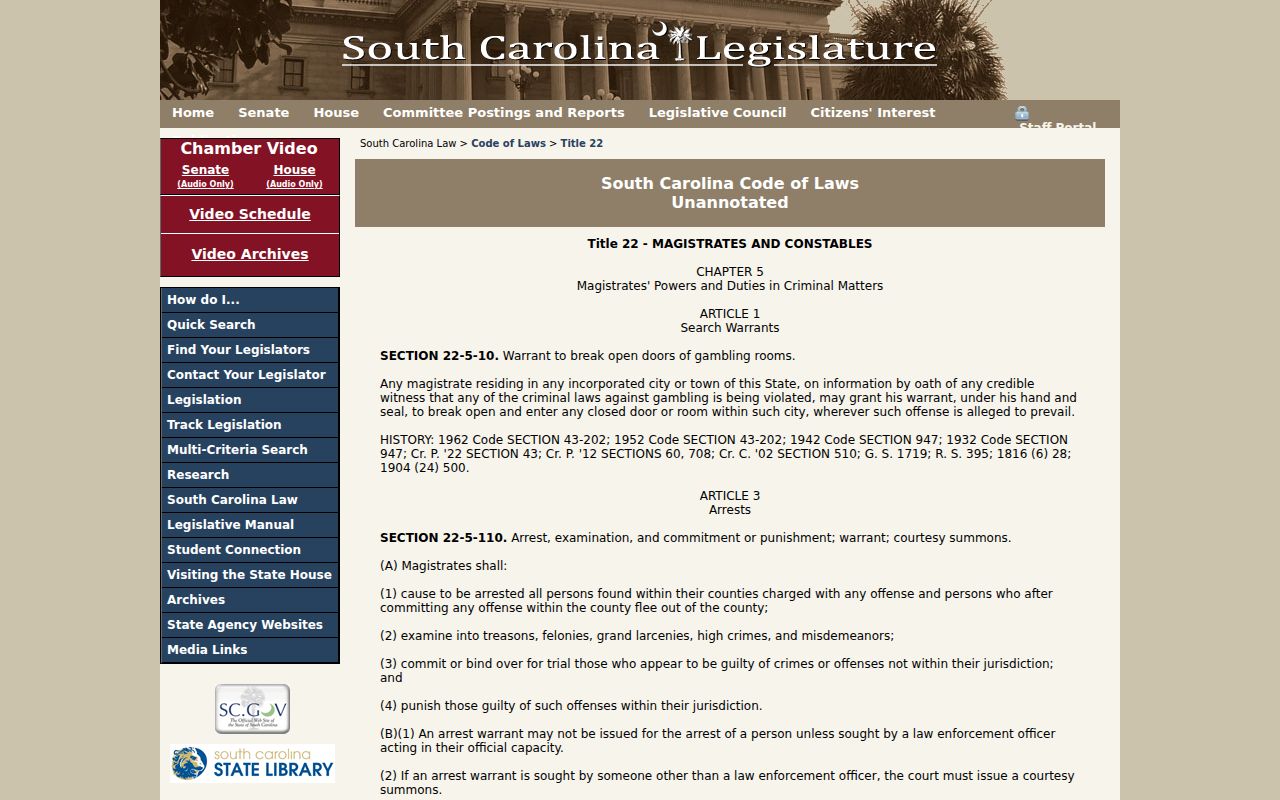
The statute alone cannot tell you how a particular Marion County complaint was resolved. The issuing court's own record shows whether it produced a warrant or a summons.
What a Marion County Arrest Warrant Contains
State form families and court rules point to the likely contents of a warrant. No public Marion County sample pins down the local labels, warrant-number format, or which fields a requester actually sees. Treat any field list as a guide to the paperwork, not a promise about every copy.
| Form reference | SCCA413A, official statewide addendum label, not a local number |
|---|---|
| Court and case | Issuing court, county, division, and case or warrant ID where assigned |
| Charge | Offense or sworn complaint reference, if included |
| Issuance | Issue date and judicial signature or authorization |
| Bond and return | Release terms and later service/return information when public |
| Privacy | Identifiers may be withheld or redacted by law or court order |
Marion Clerk Processes Arrest Warrants
The Marion County Clerk of Court keeps Circuit, Family, civil, and criminal records and processes arrest warrants, according to the office's own page. It also offers a copy-request route for filed records. Be clear about the limits: the Clerk is not the warrant-serving agency, and it makes no promise of a walk-in status determination for every court. For a General Sessions case or any known filing, reach the office at 1305 N Main Street in Marion, or call (843) 423-8240. Copies run $8 per document, with accepted payment types posted. Ask whether the exact record is public and whether a redacted copy or a scheduled visit is required. The Clerk of Court's official page spells out this record role along with full contact details.
How Marion County Arrest Warrants Are Served
Serving a warrant falls to the Sheriff and whatever law-enforcement agency fits the court and the case. City police may handle municipal process. Rule 30 addresses service efforts and reporting for bench warrants, but it is not a public service-status portal. Marion County's Sheriff page lists law-enforcement, detention, court-security, and civil-service work, yet it offers no status map, active list, or warrant lookup of any kind. So an online record can tell you nothing about where officers may go or how a warrant will be served. Confirm status with the issuing court. Then speak with counsel about a lawful response.
Marion County Sheriff and Court Roles
Each Marion County office holds one piece of the warrant picture. The judge or magistrate decides whether to issue process and controls bond, appearance, and recall. The Clerk keeps filed court documents and explains copy procedures. The Sheriff handles law-enforcement service and can route agency questions. The Detention Center manages custody and bond routing, not court disposition.
Arrest Warrant vs Summons vs Bench Warrant
Arrest warrant, summons, and bench warrant are different forms of Marion County court process. A case can shift from one to another, so rely on the current order and ask the issuing court what it requires.
| Process | Purpose | Key distinction |
|---|---|---|
| Arrest warrant | Authorizes arrest on probable cause | Begins or advances an arrest process |
| Summons | Requires a court appearance | Notice itself is not a warrant |
| Bench warrant | Addresses a missed appearance or court duty | Issued by the court handling the obligation |
A Marion County Record May Be Restricted
Not every Marion County record shows up in a search. South Carolina FOIA opens existing public records but allows exemptions. Juvenile matters sit behind Title 63, Chapter 19. Sealed files, privacy-protected identifiers, and law-enforcement investigative material can also be withheld or redacted.
Public access rules: Title 30, Chapter 4 covers FOIA and exemptions. Title 63, Chapter 19 protects juvenile information. Judicial Branch Rule 10 guidance addresses public court access.
A limited or empty search never proves that no Marion County process exists. Ask the issuing court about the case through an authorized route.
What to Do If There's a Warrant for You
Start by gathering the court name, case number, and any notice, then call the issuing office or a lawyer. Ask whether the court allows a scheduled appearance, a motion to recall or quash, bond, or another step. Showing up voluntarily does not guarantee you will avoid arrest or booking. Marion County publishes no universal surrender policy, so ask before you act.
Confirm before travel. Call the court to learn its current process and speak with a South Carolina attorney when an arrest warrant may be active.
After a hearing or a bond payment, ask how the court records the outcome and whether the Sheriff needs an updated order. Release, payment, or a missing online entry is not proof that a warrant was recalled. The safer record of the court's action is written or docket confirmation.
No Marion County Warrant Number Lookup
Marion County publishes no searchable Sheriff portal, no warrant-number format, and no county result field list. The state forms give a general schema only. They hold no live record. The South Carolina Public Index can help you find eligible court cases, and the traffic search covers participating ticket records. For an existing record, use the Clerk's copy process or file a narrow county FOIA request. The county FOIA instructions lay out response periods, deposits, search charges, and delivery options. Ask for a specific case document. For the broader check sequence in Marion County, use the Marion County warrant search steps.