
Bench Warrants in Marion County
A bench warrant is court process tied to a required appearance or some other court obligation. The clearest Marion County example comes from a criminal case where a person failed to appear or failed to post bond. Which court set the requirement matters a great deal here. Magistrate, Municipal, and Circuit Court records do not sit on one shared list. Use whatever term appears on your notice. South Carolina's own materials use both bench warrant and arrest warrant. Marion County's official sources do not use the word capias, so treat that label for an unpaid fine with caution and stick with the wording the court used.
Marion Magistrates Office Names the FTA Trigger
The county Magistrates Office page warns that failure to appear or post bond in a criminal matter results in a bench warrant. That same page adds a second sting: a traffic failure to appear or bond issue can put the home-state motor-vehicle division on notice, and a license can stay suspended until the matter is cleared. This is why a missed date calls for a phone call to the court, not just an online payment. Ask whether an FTA event was entered, whether a warrant issued, and which step the court accepts now. The ticket number alone will not answer that.
How a Bench Warrant Is Issued
South Carolina Criminal Rule 30 spells out the mechanics of bench warrants in Marion County and everywhere else in the state. The warrant must use the prescribed form and carry the trial judge's signature, or the clerk's signature at the judge's direction. The Sheriff or the appropriate law-enforcement agency then makes reasonable efforts to serve it and reports back as the rule requires. The official Rule 30 page lays out that full process, and it stands as a rule reference rather than a sample of any Marion County defendant's record.
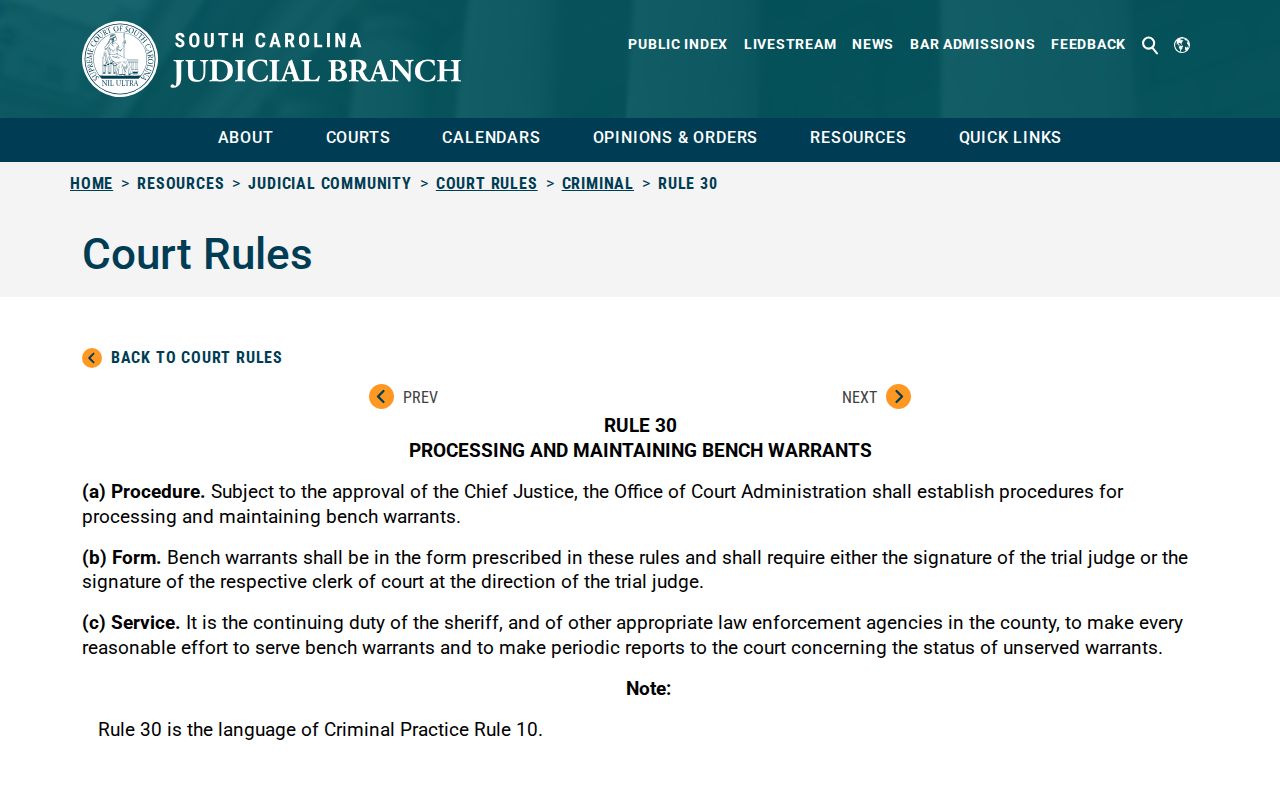
The rule explains court paperwork and law-enforcement duties. It promises no Marion County walk-in window or public search screen.
Bench Warrant vs Arrest Warrant
Both warrants can end in custody. The difference is the reason. A bench warrant answers a court requirement; an arrest warrant starts a criminal arrest process on probable cause. In Marion County, the court document itself, not a website label, controls the exact terms.
| Document | Typical reason | Who controls next steps |
|---|---|---|
| Bench warrant | Missed appearance or failure to comply | Court that set the requirement |
| Arrest warrant | Probable cause in a criminal matter | Issuing court and case process |
| Summons | Notice to appear | Court named in the notice |
City Bench Warrants Stay With the Municipal Court
Marion, Mullins, Nichols, and Sellers each run a Municipal Court. A city court handles its own ordinance and traffic matters, including a failure to appear. The statewide municipal Public Index help list dated September 8, 2026 does not include these four courts, and the Marion County traffic page notes they fall outside its online-payment route. So call the court printed on the citation. Do not assume the county Clerk or Sheriff can confirm or recall a city-court warrant. The Judicial Branch Marion directory lists the county's court contacts.
How to Resolve a Marion County Bench Warrant
Start by confirming the issuing court and the warrant's current status. Ask what that court permits: a scheduled appearance, an attorney-filed motion to recall or quash, bond, payment, or another step. Recall or quash means the court withdraws or sets the warrant aside. Only a Marion County judge can make that call.
Plan before you go. Marion County publishes no universal walk-in recall window, amnesty event, or promise that voluntary surrender avoids arrest. Speak with counsel about your case and ask the court what to expect.
After any hearing or payment, ask how the Marion County court will record the result. Ask whether it notifies the Sheriff or motor-vehicle agency. Keep the receipt, then check the docket later. Payment, release, and warrant recall can be separate events.
A Missed Traffic Date May Affect a License
The Magistrates Office says a traffic failure to appear or bond issue may send notice to the person's home-state motor-vehicle division. That is a consequence path, not a public statewide warrant system. Ask the issuing court whether it sent notice and what clears the court's FTA entry. Timing matters too. Marion County traffic instructions say cases can take one to two weeks to be submitted, and online payment processing may take two to three business days. Those estimates say nothing about when a warrant gets recalled. A city ticket must go to its city court.
Which Marion County Court Issued It
For a General Sessions case, contact the Clerk of Court at 1305 N Main Street, Marion, at (843) 423-8240. For a Magistrate case, call (843) 292-5238 at the Highway 76 office in Mullins. The Sheriff's Office at 1811 N 501 Bypass can address service or agency routing, and the Detention Center answers custody and bond-routing questions. A city court notice starts with that city clerk. A federal bench warrant runs through the Florence federal court and U.S. Marshals channels, not the Marion County Public Index.
Rule 3 Moves Serious Cases to General Sessions
South Carolina Criminal Rule 3 governs timing. Papers move from a magistrate, municipal judge, or authorized official to the Clerk for General Sessions, and then to the solicitor. That is internal court processing. An online Marion County index may lag behind each step, so a blank entry proves little. The Rule 3 text helps when a case climbs from a summary court toward Circuit Court. Ask the Clerk which case number and division hold the file now.
Marion County Bench Warrant Record Fields
Marion County publishes no sample bench warrant with names removed, and no local status-code list. The state court's SCCA413 Bench Warrant and its SCCA413A addendum show what form fields look like. Public access still depends on the record and any restriction.
| Form family | SCCA413 / SCCA413A, statewide form IDs |
|---|---|
| Case data | Court, party, case identifier, date, charge or FTA reason where included |
| Authority | Issuing judge or authorized signature |
| Service | Return or service details when part of the record |
| Access | Sealed, juvenile, or investigative material may be withheld or redacted |
A field list is only an illustration. It is never a live Marion County record for a person, so request the actual filing from the office that keeps it.
Marion County Bench Warrants and Record Access
The Clerk keeps filed court records and posts a copy route. A Marion County FOIA request can reach existing non-exempt agency records. FOIA cannot force the county to create an answer or release protected material. Juvenile records, sealed files, and investigative records may be restricted.
Official record rules: South Carolina FOIA, Title 30, Chapter 4; juvenile records, Title 63, Chapter 19; and the state bench-warrant form page.